Least of all, those at whom it is directed.
I don't share too many sermons, and I am well aware that many do not want to be sermoned-to. But in this one, I am trying to personally relate, from my own experience, what it feels like to feel racism. It's personal, hopefully not judgmental. The Gospel is only good news if it is for people. Not just for "souls" to the neglect of bodies. The Gospel, if good news, is for life; physical, practical, this-worldly life. We are in this together. Together.
Sincerely,
The Rev. Dr. GarbageMan
https://youtu.be/7-VqMEcQiio
Monday, June 15, 2020

Monday, March 30, 2020
Neighbors in the Time of Cholera
It is the season of Lent, after all. A time traditionally acknowledging the reality of inevitable social distancing, separation, and death--especially our own. A time of simplifying. A time of retreat. The whole point of which is to find a deeper joy, a source of life that does not depend on the impermanence of toilet paper, or money, or a job, or status, or even food.
I do not trivialize. These are all important. But "life is more than what we will eat and what we will wear. So be anxious for nothing." (Matthew 6). These, I think, are the most ignored words of Jesus in Christian history.
I went on a walk yesterday. It was a fine and pleasant walk. Strange too. No traffic on W. 7th. Families out walking--together!
I came down Michigan Street toward Cooper's SuperValu, I was met by the gorgeous tones of a lone saxophone.

I do not trivialize. These are all important. But "life is more than what we will eat and what we will wear. So be anxious for nothing." (Matthew 6). These, I think, are the most ignored words of Jesus in Christian history.
I went on a walk yesterday. It was a fine and pleasant walk. Strange too. No traffic on W. 7th. Families out walking--together!
I came down Michigan Street toward Cooper's SuperValu, I was met by the gorgeous tones of a lone saxophone.
I was not in any hurry, so I approached and listened. Filled with appreciation, I opened my wallet and had nothing but a $10 in there, with which I happily parted. He paused and we introduced ourselves from a distance.
Bob Neighbors told me his main instrument is harmonica, but today he felt like people needed saxophone. "Nothing connects people like music," he said, "especially when we make it together; but also when we just listen." His momma down South where he grew up used to tell him, "Don't hide your gift under a bushel basket." Share it with the world. The world needs your God-given gift. "My gift is not great," he said. "Like I said, I'm a harmonica player. I just play sax well enough not to get tomatoes thrown at me. Furthermore, I'm an introvert. It's my inclination to hold back. But today, at this time, people need connection! So I showed up. Here I am. Putting a vibration out that comes from love. It's a spiritual thing. Music can change the world. I believe that. Every musical vibration is eternal, so we gotta make it our best."
I listened. I felt what he was telling me, and the power of his simple music. I thought about how true it is that music perfectly captures both our connection and our distance from each other. It's vibration. I thought about how whatever vibration we put out into the world, for better or for worse, has infinite repercussions. I am convinced, however, that in the end all is swallowed up in love, and that what we put out in love is eternal life.
Just then, a neighbor I already knew came out of the grocery store. I introduced Jim to Bob, and we chatted a bit. Jim had a problem, though. While in the store, he decided to buy more than fewer groceries so that he would not have to go back for more for a while during the pandemic. He had four heavy bags and about 1/2 mile to walk. He asked for help to carry them, and I was more than glad to do so. We bid goodbye to Bob and set out.
During the walk, Jim Sazevich, an amazing freelance local historian, began to muse on the cholera outbreak of 1854 in St. Paul. You know, like historians do. Inspired obviously by the present Covid-19 outbreak, his mind went to 1854 and a subject close to home for him.
You see, his home, a little brick house on Smith Ave. built in 1854, was never finished by the original builder, one Mr. Adams, who had just moved to St. Paul in that year with his new bride. Young Mr. Adams was a shirt-tail relative of John Quincy Adams, former President of the US.
The small brick structure was finished in 1854, though not the intended wooden additions. That year cholera invaded St. Paul, and it killed an unrecorded number of people, "but certainly dozens," Jim told me. One life claimed happened to be Minnesota Territory's most famous citizen, Mr. Charles Fillmore; brother of then-President Millard Fillmore. Fillmore's house was in Irvine Park, just next door to Alexander Ramsey's house. It was mere blocks from The Adam's house. And Mrs. Adams was pregnant.
Death must have seemed everywhere in that little settlement. The funeral for Fillmore processed by horse-drawn hearse down Fort Street, now W. 7th St., toward the new Oakland Cemetery, St. Paul's first cemetery.
But as black crows gathered and cawed in the trees lining the street (I embellish, sorry Jim), the hearse caught a rut in the dirt road. The coffin slid off the back of the hearse-wagon and crashed on the ground, spilling the body of Minnesota's most famous citizen out onto the dirt.
We don't know, but it is hard to imagine the pregnant Mrs. Adams and her husband were not present for this spectacle that occurred only a block or two from their residence.
Thereafter, the Adams family walked away from their house and St. Paul. They just walked away--70 miles they walked, she pregnant--to Steele County MN, where their son was born: the first white child born in that county.
And now Jim lives in their house. He has learned their story, and even has a wedding photo of Mr. and Mrs. Adams in his (their) house. He is in touch with their descendants. "We need to preserve the artifacts," Jim tells me with genuine passion. "They are gone, but the artifacts remain, and keep them with us, keep us with them. And they still have much to tell us."
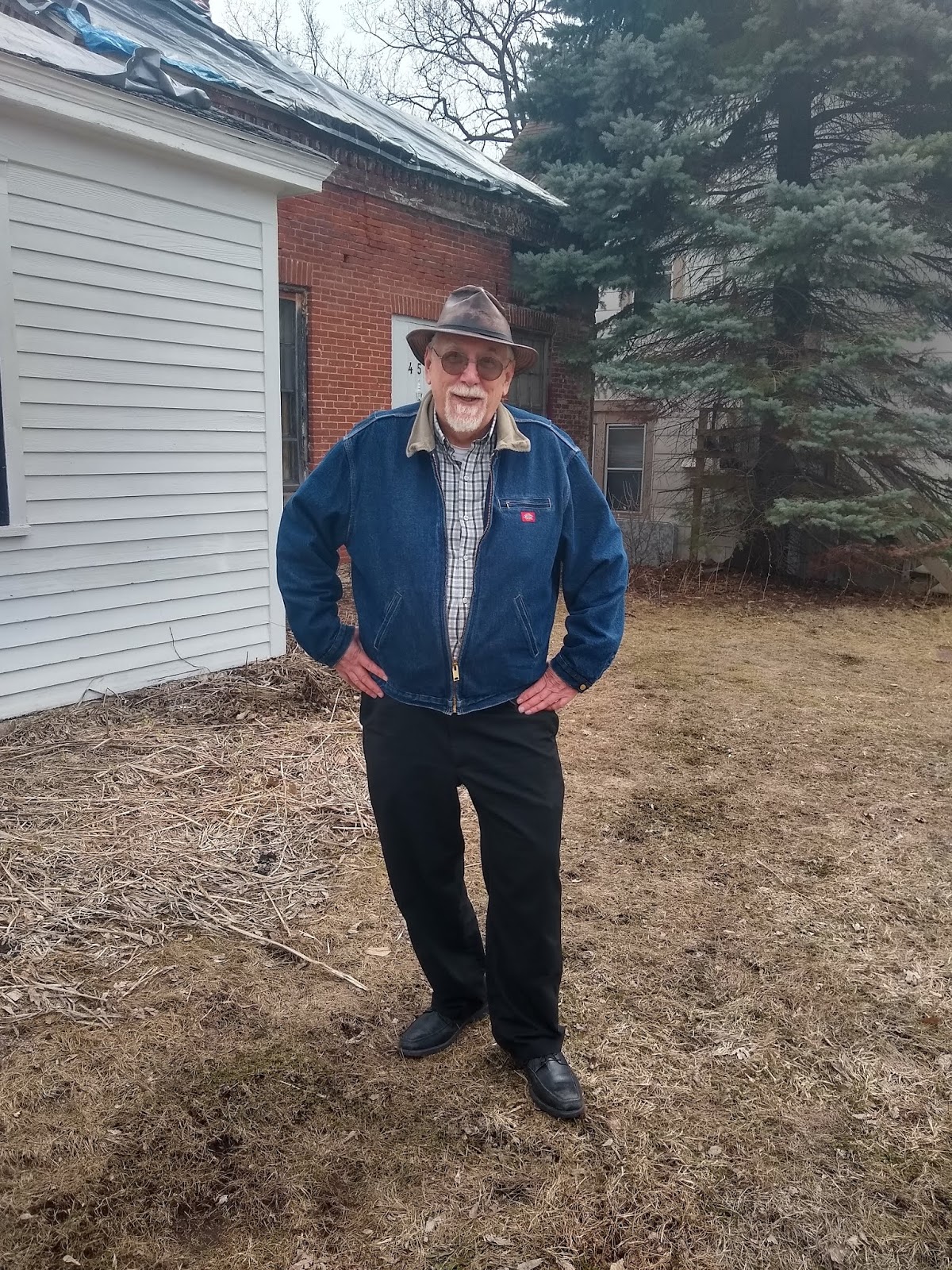
I am moved by the people who put good vibrations out into the world, who follow the calling of Love. This was quite a day. Thank you Bob and Jim, for being great neighbors, and doing good and healing work, during this contemporary "Time of Cholera."
Monday, January 13, 2020
"I Feel Safer on the Street"
It took me a minute to realize that the ringing church bell I was hearing was ours. Strange, because it was not Sunday. It was Thursday and we were in the middle of our weekly Thursday activities at 11 a.m.
I am pastor at Zion Lutheran Church in the urban Midway Neighborhood of St. Paul, MN. Every Thursday our doors are open to any who can use a home made meal, a bag of groceries, a warm place to spend the day, and/or a little safe, welcoming human contact.
There are surprises often enough on Thursdays at Zion. But this was a new one. Someone had made their way into the sanctuary and up to the balcony and, finding the rope for the bell, began ringing it like mad.
I excused myself from a small group discussion, muttering something that rhymes with "What the bell?", I made my way to the sanctuary and asked the silhouette of a man I could see in the dim light to please stop. And he did.
I climbed the stairs to the balcony and found him sitting on a church pew in the dark. He was young, barely more than 20, in a jacket and sweatpants, thick black hair, strong build, and agitated--though not in a threatening way, just incredibly fidgety.
I thanked him for listening to me about the bell. I asked his name:
"Ben."
"Are you ok?"
"No, not really."
"You seem really nervous."
"Yeah, I feel real anxious."
"Are you on any drugs right now?"
"Yes, amphetamines, I need them to feel normal."
At this point I invited him down to my office to talk if he'd like to. He agreed, gathering up his bags. He was unsteady on his feet and his sweatpants kept slipping down.
In my office he couldn't sit still. He paced as we talked. He rearranged some books, turned on the stereo to some music he likes, and then sat at my desk and took notes on my note pad during our talk.

He grew up in Hastings, always suffered anxiety, and was hard on his family. He left home early and has bounced around in shelters and under bridges. Said he wants to get clean and heard Teen Challenge was a good place. I called and spoke to Stephanie, a counselor. She was amazing and spoke with Ben directly. No, he could not come there without a rule 25 chemical dependency evaluation, and their next appointment was next week.
Stephanie told him she had been where he is. She recommended going to St. Joseph's Hospital, as she had done. He could detox in safety, with attendant drug therapy. It was his best option. We thanked Stephanie. Then Ben used my phone to call his sister for advice. She agreed with Stephanie. "St. Jo's is your best option. Please go," she said.
But he could not. I offered to drive him. Appealed to the good advice he just received. "They will put me in the Psych Ward. I can't go there again. It's too confining. I feel safer on the street."
With that, Ben grabbed a doughnut and a coffee, and hit the street.
"Left the building."
Yet he definitely had rung our bell.
I am pastor at Zion Lutheran Church in the urban Midway Neighborhood of St. Paul, MN. Every Thursday our doors are open to any who can use a home made meal, a bag of groceries, a warm place to spend the day, and/or a little safe, welcoming human contact.
There are surprises often enough on Thursdays at Zion. But this was a new one. Someone had made their way into the sanctuary and up to the balcony and, finding the rope for the bell, began ringing it like mad.
I excused myself from a small group discussion, muttering something that rhymes with "What the bell?", I made my way to the sanctuary and asked the silhouette of a man I could see in the dim light to please stop. And he did.
I climbed the stairs to the balcony and found him sitting on a church pew in the dark. He was young, barely more than 20, in a jacket and sweatpants, thick black hair, strong build, and agitated--though not in a threatening way, just incredibly fidgety.
I thanked him for listening to me about the bell. I asked his name:
"Ben."
"Are you ok?"
"No, not really."
"You seem really nervous."
"Yeah, I feel real anxious."
"Are you on any drugs right now?"
"Yes, amphetamines, I need them to feel normal."
At this point I invited him down to my office to talk if he'd like to. He agreed, gathering up his bags. He was unsteady on his feet and his sweatpants kept slipping down.
In my office he couldn't sit still. He paced as we talked. He rearranged some books, turned on the stereo to some music he likes, and then sat at my desk and took notes on my note pad during our talk.

He grew up in Hastings, always suffered anxiety, and was hard on his family. He left home early and has bounced around in shelters and under bridges. Said he wants to get clean and heard Teen Challenge was a good place. I called and spoke to Stephanie, a counselor. She was amazing and spoke with Ben directly. No, he could not come there without a rule 25 chemical dependency evaluation, and their next appointment was next week.
Stephanie told him she had been where he is. She recommended going to St. Joseph's Hospital, as she had done. He could detox in safety, with attendant drug therapy. It was his best option. We thanked Stephanie. Then Ben used my phone to call his sister for advice. She agreed with Stephanie. "St. Jo's is your best option. Please go," she said.
But he could not. I offered to drive him. Appealed to the good advice he just received. "They will put me in the Psych Ward. I can't go there again. It's too confining. I feel safer on the street."
With that, Ben grabbed a doughnut and a coffee, and hit the street.
"Left the building."
Yet he definitely had rung our bell.
Friday, July 26, 2019
Homily for Gary Michel, Mayor of the Midway
Some have asked me for a copy of the homily I gave for Gary. Here it is:


Homily for Gary Michel Memorial
7/11/19
Zion Lutheran Church
John Marboe, Pastor
John Marboe, Pastor
Gospel Lesson: John 3. 1-8
Now there was a Pharisee named Nicodemus, a leader of the
Jews. He came to Jesus by night and said to him, ‘Rabbi, we know that
you are a teacher who has come from God; for no one can do these signs that you
do apart from the presence of God.’ Jesus answered him, ‘Very truly, I
tell you, no one can see the kingdom of God without being born from
above.’Nicodemus said to him, ‘How can anyone be born after having grown old?
Can one enter a second time into the mother’s womb and be born?’ Jesus
answered, ‘Very truly, I tell you, no one can enter the kingdom of God without
being born of water and Spirit. What is born of the flesh is flesh, and
what is born of the Spirit is spirit. Do not be astonished that I said to
you, “You must be born from above.” The wind blows where it
chooses, and you hear the sound of it, but you do not know where it comes from
or where it goes. So it is with everyone who is born of the Spirit.’
I never spoke with Gary about what his
wishes for his own funeral might be. But if I had, I am quite sure that Gary
would have said something like: “Keep it short. And no BS!”
I will attempt to honor that!
A minute ago, Gary’s brother Tom
shared how he tried to help his kids understand their Uncle Gary: “Your uncle
is kinda like the wind.” He said. “He shows up when you don’t expect, and goes
when and where he wants.”
In the Gospel story, this is how
Jesus describes people who are “born of the Spirit.” But this passage is about more
than unpredictability. It is about
letting go of those things the world tells us give life, but do not. And it is
about the life that comes from living in Christ’s Spirit (by the way, in
biblical Greek “wind” and “spirit” are the same word). It is descriptive of
people “born from above,” or “born again.”
And Gary was born again into a life
of the Spirit/Wind.
For many Christians, to be “born
again” is something like a badge of membership that distinguishes those who
“belong to Jesus” from the rest of humanity…forever. For them it is an entry
ticket to heaven, and without it you go to hell. I spoke to Gary plenty about
these matters, and we agreed that this idea is baloney and bad for the world.
It is just this kind of judgement,
of othering others, of religious distinction, and of self-righteousness that
Jesus protests in the Gospels.
Rather, to be “born again” is to let all that stuff go, and to begin life anew
with a new sense of humanity; one
that is on the side of life—abundant life, of compassion, and of healing. For all people.
Gary was, in this sense, born again.
He was awake to what really mattered
in life—and what did not. As was said earlier, he would help anyone. Anyone. Okay,
he might grumble and be critical while doing it. But there he was.
He rejected the path of accumulation,
of reputation, or of recognition. These simply did not matter to him.
What he cared about was quite
simple. To pursue knowledge, to care for others, and to show up each and every
Thursday here at Zion to serve food to persons in need…AND to yell at us that
we weren’t doing things right. Which we all experienced. Me included. Yep he
yelled at me too.
Which brings me to another image
Jesus used, besides wind.
In Matthew’s Gospel, in the Sermon
on the Mount, Jesus turns to his disciples and says: “You are the salt of the
earth. But if salt loses its saltiness, it is no longer good for anything but
to be thrown out and trodden under foot. So have salt, and be salty!”
Gary was salty.
He was salty in that Irish way of
speaking: “Aye, he’s the salt o th’ arth!”
Which means: He swore like a sailor.
He had no airs. He drank (until he didn’t anymore). He could be rough around
the edges. He told it like he saw it. But
he had a heart of gold.
I love this image because it is so
earthy. I love this image because it is not churchy.
I love it because it expresses
something of how we are to be here in the world.
Gary. Was. Here.
He was fully present. He was fully
himself. For better and for worse. He showed up!
100%.
Now that was not always, nor by
everyone, exactly appreciated.
But Jesus never called anyone to be
“nice.” Not once.
But salt. Salt is an essential
element for life. Without it we die. To be sure, too much of it is not good
either! But it is embedded in the life of the world, essentially.
We all know that salt was a
preservative in the ancient world. It made food last and helped people survive
the seasons of life.
What we may not know is that salt
was essential to healing. I used to think that “to rub salt in a wound” was a
phrase that meant to be cruel to someone who was already down. But salt was the
most basic and universally available antibiotic.
Soldiers rubbed salt in their wounded comrades to prevent infection, so that
they might heal. Yes, it stung like mad, but it was applied for healing.
It is striking that Gary’s two main
senses of vocation were: to heal and
to feed people. He trained during
Vietnam to be a medic, and later became an RN. After that he went to culinary
school to become a chef. Eventually he came to help in our kitchen at Zion. Gary
was a healer. Gary fed the hungry. Encountering Gary could sting, but he was
salt; on the side of life and of healing.
Gary was and is like wind and salt.
But we are here not only to ponder Gary’s life. We are here in this liminal
space, this in-between space, between life and death, to ponder our own
lives…in light of Gary’s life. It is from this perspective, from the
perspective of the end of life, that life can be viewed with greatest clarity.
And if you are anything like me, you realize from this point of view how much
energy, time, money, fear, and worry we spend on things that, from this
perspective, don’t really matter much at all.
What really matters? It becomes
quite simple. For what really matters boils down to one thing:
What matters is getting ice cream cones
with your brother’s kids and carrying them home, ice cream melting down your
shirt.
It’s just one thing: Showing up as
Santa for the kids every Christmas.
Just one thing: Feeding the hungry
while being an ornery cuss.
Just one thing: Caring for people
with huntington’s disease as a nurse.
Just one thing: Love.
Gary was moved by love. Imperfectly,
but real-ly. Wholly. Saltily. Windily.
And this is eternal life. Eternal
life is not a very long time after you die. Eternal life has nothing to do with
time. It is outside of time. That is what “eternal” means. No time.
Eternal life is not a quantity of
life. It is a quality of life. It is the life of love And that life is
available and present both now and forever. It is available to all of us. All
the time. No matter how much or little time we have. No matter how strong or
weak we feel. The one thing that truly matters, that lasts forever, and that is
the very life of heaven, is available to all of us. To love.
Gary is with God. No one can understand
quite, nor describe adequately what that means. We are too limited in our
imaginations, too narrow in our experience and thinking. However:
The best description I ever heard
was from a three year old girl. Who is my daughter. She is no longer three, but
when she was, we visited the graveside of our cat Harvey who had died shortly
after she was born. We stood around the grave, under the maple tree in our back
yard. My wife Andrea asked our daughter, Charlie, “Where do you think Harvey
went?”
Without hesitation, Charlie
proclaimed, “Into the world, Mommy!”
(long pause)
It is the best description of heaven
I have ever heard. Not: Up to heaven. Not: Into the ground. But: Into the
world.
We tend to think of heaven as some
other place, absent from here. But where is God?
If God is anywhere, is not God
everywhere?
Gary is with God. Therefore Gary is
present—forever with you, as salt and as wind. His love the very reflection of
God’s love that makes and redeems the world.
Love is eternal life. Is a gift. Is
grace for everyone, no exceptions.
I hope that was not too long, nor
BS.
Friday, June 21, 2019
The Mayor of the Midway
Gary rode a bike. Everywhere. Wearing flip flops in the summer, and high tops without laces in the winter. I met him four years ago when I came to Zion Lutheran Church as the new pastor. I met Gary my first Thursday morning, and every Thursday since. Every Thursday, a crew of volunteers shows up to transport food, cook, fill grocery bags and serve the 50 or so people who show up in need of a meal, some community, and a bag of groceries. Gary's one of them. Turns out, Gary is one of the reasons I came to this small urban parish, though I did not realize it at the time, and one of the reasons I have stayed.
It is unclear to me whether Gary ever became a "member" of the church, a formal distinction that has become increasingly irrelevant over the years. He was present--he showed up--and that is what matters. Not on Sunday, mind you, or very rarely, but every-single-Thursday. Rain storm or blizzard, he was there. As is always the case with many of our volunteers--he was not unique in this regard--they show up to feed people in need. They show up. It's what they do. On bike, on foot, in cars, by Metro Mobility.
Yet Gary was special. He first came to Zion (years before I arrived) to receive some food. Then he volunteered. At that time he worked at Menards on the overnight shift stocking shelves. After their shift he would come to Zion on Thursday mornings with Lee, his co-worker, to help unload our vehicle full of groceries from St. Vincent de Paul. Then he and Lee would help sort the groceries into bags for distribution. But Gary and Lee would leave before lunch to go home and sleep.
Gary was in his middle sixties. Lived simply on his hourly at Menards, Social Security and benefits as a Vet. He was a medic during Vietnam. He volunteered to go into combat and wanted to be "in the action." Instead, he was stationed in Germany to treat the airlifted injured, while his friend from training who did not want to see combat was sent to Vietnam. His friend came home, but was never whole again. Gary volunteered for Airborne, but shattered his leg in a parachuting drill, and was discharged from the Service. He became an RN, and worked in his hometown of Lacrosse, WI, then Midway Hospital in St. Paul, until his back gave out. He attended culinary school and had various jobs in and out of food service.
I learned quickly that Gary knew things. He had street smarts, people smarts, and medical smarts. He would take me aside during our Thursday community meals and school me about various guests. "That guy is a thief." "That one's a big-time druggie. Eats pills by the fist-full. Messed up big-time by 'Nam." Never one to sugar coat, he would spit a little out of the space where he missed two lower teeth when he was speaking with emphasis. Dental care was not top priority. But reading and learning--especially history--especially military history--was. He rode bike to the library daily, read the newspapers, and devoured books.
He never married because he "never wanted to live with a woman." But he did have women friends who were dear to him, and vice versa.
On more than one occasion, his medical knowledge was crucial--probably saved a life. One of our regular guys, Dave, was short of breath, weak, and had some chest pain. Dave insisted he'd be ok. Gary called 911 and informed Dave he was going to the hospital or he was going to croak. It was true. Dave had 16% heart function when they tested him in hospital, and he is still with us today.
Not long after that, Gary, not a paragon of heart-healthy living, experienced his own heart attack. He was alone and at his apartment. He knew exactly what was happening and knew he could not make it alive to the VA hospital by public transport (take note, 911 and ambulance will not take our Vets to the VA in emergencies, and many of them are not covered elsewhere). He called Linda, our equally no-nonsense head cook, for a ride. She dropped everything that night and got him there, just in time for life-saving open-heart surgery on that great big heart of his.
On Thursday, June 6th, Gary did not show up. Everyone knew something must be wrong, since it was impossible that he would not be there and not let us know. We called 911 and asked for a wellness check at his apartment. The police went and found his apartment empty. The manager knew nothing. At the beginning of the community we prayed for Gary, wondering and worrying. Just after that I called the apartment manager once again.
Gary was dead. He had been struck by a vehicle on his bike two evenings before. Gary's brother had called the manager. I conveyed the news to our people during the community meal, and there was an audible gasp. This beloved, crusty, sometimes off-putting, heart of gold, salt of the earth pillar of our fragile/fractured/helping community--was gone.
He asked me this spring if I play golf. I said yes. He said, "So do I. Let's play this summer." I was really looking forward to golfing with this beautiful man who might show up in his high-tops without laces. That would have been fun.
 |
| Gary's on the left, with Dan, another volunteer |
Yet Gary was special. He first came to Zion (years before I arrived) to receive some food. Then he volunteered. At that time he worked at Menards on the overnight shift stocking shelves. After their shift he would come to Zion on Thursday mornings with Lee, his co-worker, to help unload our vehicle full of groceries from St. Vincent de Paul. Then he and Lee would help sort the groceries into bags for distribution. But Gary and Lee would leave before lunch to go home and sleep.
Gary was in his middle sixties. Lived simply on his hourly at Menards, Social Security and benefits as a Vet. He was a medic during Vietnam. He volunteered to go into combat and wanted to be "in the action." Instead, he was stationed in Germany to treat the airlifted injured, while his friend from training who did not want to see combat was sent to Vietnam. His friend came home, but was never whole again. Gary volunteered for Airborne, but shattered his leg in a parachuting drill, and was discharged from the Service. He became an RN, and worked in his hometown of Lacrosse, WI, then Midway Hospital in St. Paul, until his back gave out. He attended culinary school and had various jobs in and out of food service.
 |
| On the right, serving dessert |
He never married because he "never wanted to live with a woman." But he did have women friends who were dear to him, and vice versa.
On more than one occasion, his medical knowledge was crucial--probably saved a life. One of our regular guys, Dave, was short of breath, weak, and had some chest pain. Dave insisted he'd be ok. Gary called 911 and informed Dave he was going to the hospital or he was going to croak. It was true. Dave had 16% heart function when they tested him in hospital, and he is still with us today.
Not long after that, Gary, not a paragon of heart-healthy living, experienced his own heart attack. He was alone and at his apartment. He knew exactly what was happening and knew he could not make it alive to the VA hospital by public transport (take note, 911 and ambulance will not take our Vets to the VA in emergencies, and many of them are not covered elsewhere). He called Linda, our equally no-nonsense head cook, for a ride. She dropped everything that night and got him there, just in time for life-saving open-heart surgery on that great big heart of his.
 |
| A great Santa |
Gary was dead. He had been struck by a vehicle on his bike two evenings before. Gary's brother had called the manager. I conveyed the news to our people during the community meal, and there was an audible gasp. This beloved, crusty, sometimes off-putting, heart of gold, salt of the earth pillar of our fragile/fractured/helping community--was gone.
He asked me this spring if I play golf. I said yes. He said, "So do I. Let's play this summer." I was really looking forward to golfing with this beautiful man who might show up in his high-tops without laces. That would have been fun.
Wednesday, February 27, 2019
Lion King and Garbage
“
Mufasa: Everything
you see exists together in a delicate balance. As king, you need to
understand that balance and respect all the creatures, from the crawling
ant to the leaping antelope.
Simba: But, Dad, don't we eat the antelope?
Mufasa: Yes, Simba, but let me explain. When we die, our bodies become the grass, and the antelope eat the grass. And so we are all connected in the great Circle of Life.
Simba: But, Dad, don't we eat the antelope?
Mufasa: Yes, Simba, but let me explain. When we die, our bodies become the grass, and the antelope eat the grass. And so we are all connected in the great Circle of Life.
- —Mufasa and SimbaM
- Ah, the Circle of Life.
- Driving up St. Clair Avenue yesterday in the aftermath of record snowfalls, I came upon a sight that made me pull over immediately. Stuck in a drift of icy snow left by snowplows was a garbage truck, helpless as a beached whale, all of 70,000 lbs. Delighted, I leapt from my car, and approached the comical scene to find, as I suspected, my old buddy Wes shoveling at the ice and slush around the rear tires. I put my shoulder to the back of the truck and shouted, "Giver 'er some gas!" The driver, Didre, saw me in the side mirror, as did Wes, and we cracked apart laughing.
- We recounted the time together when we got stuck in a steep alley and risked destroying a garage as we worked to find traction out of a predicament. We recounted Wes paying a kid $20 to help shovel out of a spot. Then, when the truck got out and got re-stuck, the little entrepreneur wanted another $20 to help again. Wes had no more cash, so the kid started shoveling snow back in front of the truck.
- But this time we had resources. There were cables in the truck, enough to throw under three sets of tandem tires, but we had one more set of tandems in the back. We needed traction on this last set which were spinning on glare ice.
- (Here we need the Lion King theme song. Hear it in your mind...)
- I spotted in the bay of the truck a stuffed animal. It was Simba. With a red heart sewed to the bottom of his foot. I knew he could save us.
- Simba took hold. The truck was set free, but the lion sustained mortal injury.
- Wes was spent from shoveling, but would recover.
- In this world everything and everyone is connected. The benefit, pain, or sacrifice of one affects all. Life indeed is a circle of inter-connectedness. We are deluded when we don't feel this.
- Garbage, lions, toys, movies, friends, trucks, laughter, ice. One world. Funny examples. Deadly serious examples. Every single being is every single other's concern. To love one's neighbor as one's self is not a moral imperative so much as it is the statement of fact: to love the neighbor is to love ourselves. And to truly love ourselves is to love every neighbor.
- We are inseparable... in the Circle of Life.
- Word of Mufasa, Word of Truth, Amen.


Monday, July 9, 2018
Behind the Scenes: The Unabridged StoryCorps Interview
In case you have the time and interest, here is the full version of Charlie and me in the StoryCorps interview I shared a few blogs ago. Warning: it is nearly an hour and 45 minutes. But I added random photos of Charlie, and/or me that even sometimes fit with the story. Please let me know if you listen to the whole thing! By the way, the edited version that aired on NPR was less than 3 minutes. They did an amazing job. I like saying that this aired on January 21st, 2017, and garnered a larger audience than President Trump's inauguration. Please don't tell him, or we will surely get an angry tweet...
https://www.youtube.com/watch?v=YQBU7rugAW4
https://www.youtube.com/watch?v=YQBU7rugAW4
Subscribe to:
Posts (Atom)